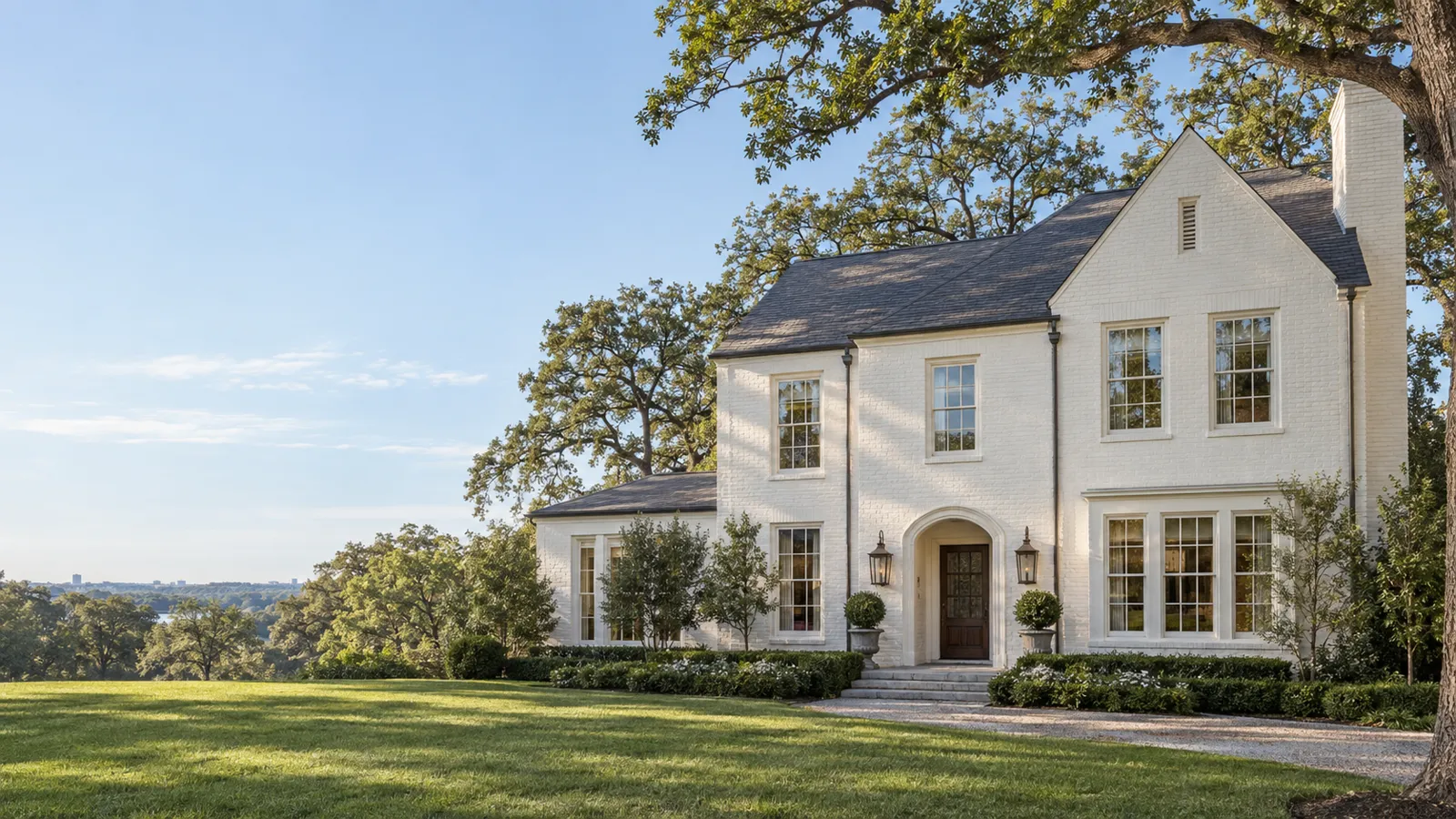
Lap siding or clapboard
Beveled boards run in overlapping horizontal courses, thin at the top and thick at the butt. Paint lets go first along the lower edge of each board, where water sits.

Rancho Cucamonga Elite Painting is San Bernardino County's trusted specialist in wood siding painting in Rancho Cucamonga, CA, specializing in T1-11 panel siding, hardboard lap siding and cedar board and batten. We offer swollen board replacement and edge sealing on plywood and hardboard.
Get a free painting estimate
Or call (909) 922-1329. Calls only, we do not receive text messages.
Our team provides oil-alkyd primer on every cut end and butt joint, delivering painting that seals the siding against water and sun for both residential and commercial projects. The crew that probes your siding board by board is the crew that paints it, and we write the scope to name each repair, the primer and the number of coats.
From sealing the bottom drip edge of a grooved plywood panel to repainting every wall of a wood-clad house, our team handles every detail. Serving Rancho Cucamonga, Upland, Montclair and Claremont, we keep painted siding tight, sealed and even in color.
Why Rancho Cucamonga Elite Painting
No salesperson hands you to a stranger. The person who measures the job answers for it.
Wood siding painting in Rancho Cucamonga starts by naming the siding, because lap boards, board and batten, grooved plywood panels and hardboard each fail in their own way and each needs its own prep. Stucco covers most houses in California, so wood siding here usually turns up as a gable, a band under the eaves, a garage wall or the whole skin of an older ranch house in Alta Loma.
Beveled boards run in overlapping horizontal courses, thin at the top and thick at the butt. Paint lets go first along the lower edge of each board, where water sits.
Wide vertical boards with narrow strips covering the joints. The battens hide movement between boards, and the top and bottom ends are all end grain.
Sheets of plywood with grooves cut to imitate boards, sold as Texture 1-11 or reverse board and batten. The panel edges and the bottom edge soak up water unless they are sealed.
Compressed wood fiber pressed into boards that look like lap siding. It is factory primed, it takes paint well while the coating is intact, and it swells once water reaches a raw edge.
Before any siding is painted, every wall is checked for swollen edges, face checks and soft wood, because paint over a failing board looks good for a season and then fails with it. The inspection is what decides whether your siding is a repaint or a repair and repaint.
Plywood siding carries small lathe checks inside its face veneer from the way the veneer is peeled. Outdoors, repeated wetting and drying lets those checks spread to the surface, and they can crack right through a paint coating. A checked panel that is still sound is scraped, primed and given a full film; a delaminating panel is replaced.
Hardboard shows water damage at its edges. A bottom course that has swollen, softened or started to flake is past painting, so those boards are replaced before the wall is primed.
Solid lumber is probed at the ends, at joints, and anywhere siding runs down to a roof, since those are the places decay starts. Siding that butts tight against roof shingles cannot be reached with a brush at its end grain, so we point it out on the walk and seal what can be reached.
The single step that most decides how long a siding repaint holds is sealing end grain and panel edges with an oil-alkyd primer before any topcoat, because those cut surfaces drink water far faster than the face of a board. Primed end grain stops paint failure near the ends of boards.
Caulk is used where siding meets trim and window casings, and never as a stand-in for flashing. A gap at a Z-flashing over a panel seam is left open as a drip edge, since sealing it traps water behind the siding.
Siding that already carries paint stays under an opaque finish, either paint or a solid-color stain, because a penetrating stain cannot soak through an old film. On T1-11 and other saw-textured plywood, paint gives the longest service of the three options, and it is our usual recommendation for panels already painted once.
An acrylic latex topcoat over the right primer builds the thickest film for the amount applied, which is what a face-checking panel needs to bridge its surface.
An opaque stain performs much like paint on siding and keeps more of the saw texture showing. It is a good fit on rough board and batten, and it can go over old paint.
Hardboard cannot take a semitransparent stain or a water-repellent treatment. It needs paint or a solid-color stain, kept continuous so no raw fiber is left open. Cedar or redwood siding that has never been painted is a different decision, with stain on the table as well. If the wall is shingles or shakes rather than boards, that choice is covered on our shingle siding page.
The process
We go around the house with you, probe the siding at its ends and edges, and mark every board or panel that needs replacing.
Walls are washed, loose paint is scraped to a firm edge, and chalky or mildewed areas are cleaned so the primer grips.
Swollen hardboard, delaminated plywood and soft lumber are cut out and replaced with matching profiles, fastened with corrosion-resistant nails.
End grain, panel edges and new boards get oil-alkyd primer, and bare spots are primed before the finish.
Siding is brushed and rolled or sprayed and back-brushed, so the coating is worked into grooves and laps rather than sitting on top of them.
We walk the walls with you and clear the punch list before the ladders come down.
Houses built before 1978 may carry lead in their old siding paint, and that job belongs with our historic home painting work, where lead-safe practices, period colors and older wood repair lead the scope. This page is for the newer stock: plywood panel and hardboard siding put up on houses and garages after 1978, and board siding on newer builds.
Association boards and managers whose buildings carry T1-11 or hardboard accents face the same failure on every building at once: bottom edges swelling where sprinklers hit and where soil sits against the wall. We can walk each building, list the replacement boards by elevation, and schedule the repair and repaint in phases. A new siding color on a house in an association generally goes to the architectural committee for written approval first.
Repairing and repainting the wood siding on a fully wood-clad house in the Rancho Cucamonga area is typically estimated at roughly $6,000 to $20,000, while a stucco house with only a wood gable, band or garage wall is typically estimated well below that range.
Every figure here is an estimate and may change once the siding has been probed; your written quote after the walk sets the final price. Call to book a free siding inspection.
Questions
Most T1-11 can be repainted if the panels are sound. Checked but solid panels are scraped, their edges sealed and given a full film of paint; panels that are delaminating or soft at the bottom are replaced first.
Painting a fully wood-clad house is typically estimated at roughly $6,000 to $20,000, depending on the square footage, the height and how many boards need replacing. A gable or accent wall on a stucco house costs much less, and your written quote sets the final price.
Water has reached a raw edge. Hardboard edges absorb water and have to stay sealed, so a swollen bottom course is replaced and the new edges are primed before the wall is painted.
Only with a solid-color stain, which behaves like paint. A semitransparent stain needs bare wood to soak into, so it will not work over an existing film.
We replace them. Every soft or swollen board found on the walk is listed on your estimate and replaced with a matching profile before any primer goes on.
Joints against trim and windows are caulked. Drip edges above flashing and the laps between boards are left open, because sealing them traps water behind the siding.
It is one part of the house. Wood siding needs repairs, edge sealing and end-grain priming that stucco does not, so we scope it separately, and it can be done on its own or alongside the rest of the exterior.
A new color usually goes to the architectural committee in writing first. Repainting in the existing color is often treated as maintenance, though your association's governing documents decide.
Homeowners get a free on-site estimate. Boards, managers and contractors can send a scope for a bid.
Licensed, insured and bonded · License #585047. Calls only, we do not receive text messages.